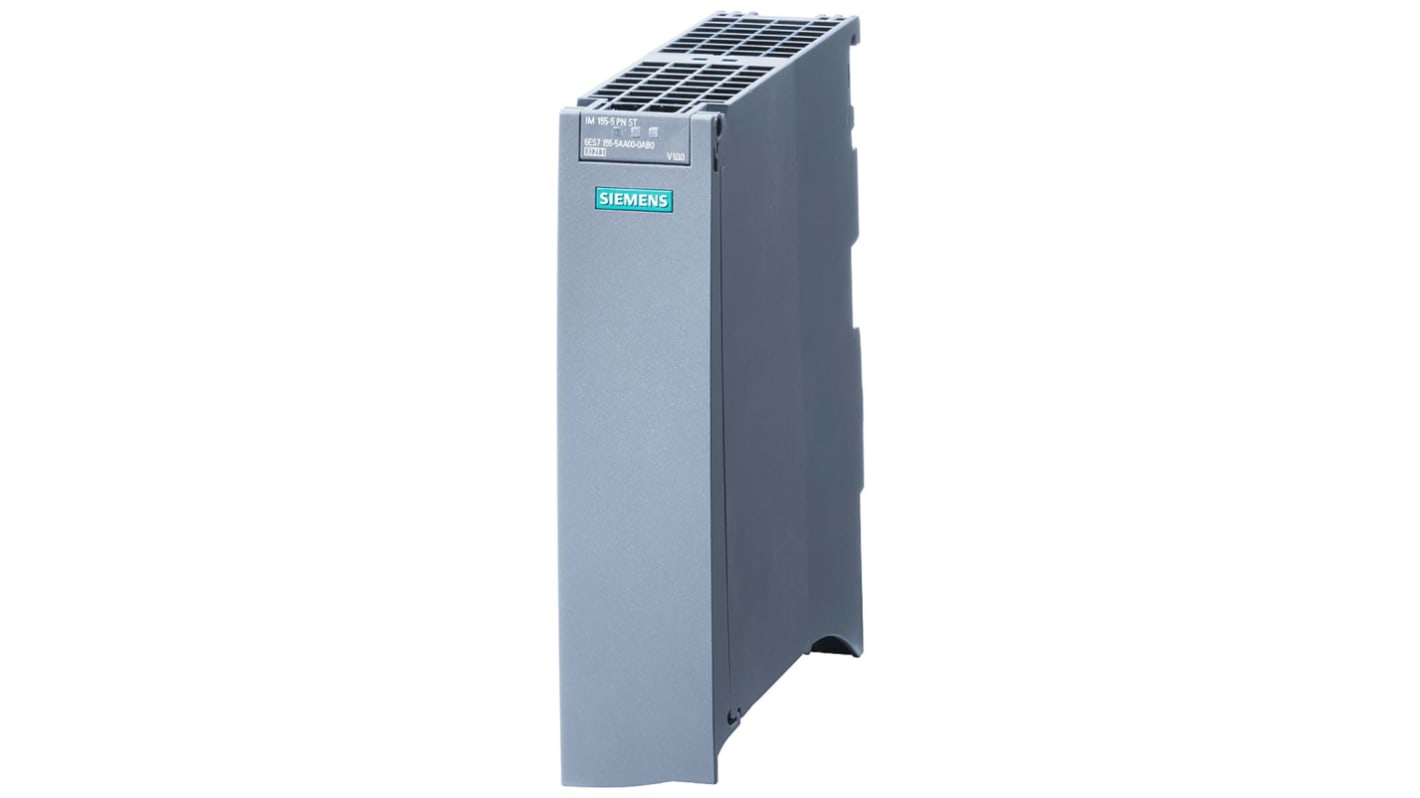
Siemens PLC I/O Module ET 200 28.8V
- RS stock no.:
- 203-4145
- Mfr. Part No.:
- 6ES7155-5AA00-0AC0
- Manufacturer:
- Siemens

Subtotal (1 unit)*
R 21 859,22
(exc. VAT)
R 25 138,10
(inc. VAT)
FREE delivery for orders over R 1,500.00
In Stock
- 1 unit(s) ready to ship
- Plus 6 unit(s) ready to ship from another location
- Plus 2 unit(s) shipping from 11 June 2026
Need more? Click ‘Check delivery dates’ to find extra stock and lead times.
Units | Per unit |
|---|---|
| 1 + | R 21,859.22 |
*price indicative
- RS stock no.:
- 203-4145
- Mfr. Part No.:
- 6ES7155-5AA00-0AC0
- Manufacturer:
- Siemens
Specification
Technical data sheets
Legislation and Compliance
Product Details
Find similar products by selecting one or more attributes.
Select all | Attribute | Value |
|---|---|---|
| Brand | Siemens | |
| Product Type | PLC I/O Module | |
| Module Type | Input/Output | |
| Maximum Supply Voltage | 28.8V | |
| Maximum Operating Temperature | 60°C | |
| Depth | 129mm | |
| Series | ET 200 | |
| Standards/Approvals | RoHS | |
| Width | 35mm | |
| Length | 147mm | |
| Select all | ||
|---|---|---|
Brand Siemens | ||
Product Type PLC I/O Module | ||
Module Type Input/Output | ||
Maximum Supply Voltage 28.8V | ||
Maximum Operating Temperature 60°C | ||
Depth 129mm | ||
Series ET 200 | ||
Standards/Approvals RoHS | ||
Width 35mm | ||
Length 147mm | ||
- COO (Country of Origin):
- DE
Siemens Interface Module, Profinet Connectivity, 24V DC Voltage Rating - SIMATIC Series - 6ES7155-5AA00-0AC0
Loop your equipment into data connections with this interface module from Siemens. By linking I/O modules to an industrial network, it carries process signals across the system to let automated machines communicate seamlessly. With its support for 100Mbps transfer rates, the unit gets information from A to B in a flash, delivering efficient results. Compatibility with the widely used PROFINET protocol means the component is a sure fit for standard networks. As it cycles through its channels in just 4ms, it keeps up with sudden signal changes to handle fast-moving applications. You'll see interface modules like this working in fulfilment centres and renewable energy installations.
Features & Benefits
• Supports full-duplex protocol, carrying information in both directions for reliable communication
• Simple rail mounting allows quick installation into a cabinet
• LED indicators for clear status signalling
• Protected against surge voltages up to 1.5kV, cutting the risk of damage from electrical faults
How many I/O devices can I connect to this module?
This unit connects up to 30 modules to a network, so it's a handy hook-up point for complex I/O setups.
Related links
- Siemens ET 200 Series PLC I/O Module
- Siemens ET 200 Series PLC I/O Module, Digital
- Siemens PLC I/O Module
- Siemens ET 200 Series PLC I/O Module, Analogue
- Siemens ET 200 Series PLC I/O Module 24 V
- Siemens ET 200 Series PLC I/O Module, 24 V
- Siemens ET 200 Series PLC I/O Module Transistor
- Siemens ET 200 Series PLC I/O Module Digital